
The Movie is about to Begin Kindly Take Your Seat
Welcome to the movie theater. My story the film will be told shortly. You will be able to get to know me, as well as hear of my development.
I was created as a puzzle in a rather long time ago. Prehistoric man stretched his hands against the light, forming a shadow on the cave wall. It was then that the idea of projection was born. The magic lantern was invented in the 17th century, and developed until the 19th century. It was one of my ancestors. Past street artists built mechanical instruments in order to create an illusion of motion in the pictures screened through the magic lantern. These instruments are my cousins. Actual cinema animation, however, was created only when the physiological phenomenon causing a picture to be engraved in the mind for some time after it disappears from sight-range was understood. During the 1830’s, it was proved that when the eye observes a rapid sequence of static pictures the mind combines them together. This is called the Vision Continuity Principle Photography, for which technology has existed since 1839, is my grandfather. Only after faster means of exposure were discovered did my grandfather marry my grandmother the camera; consequently, my father -the silent movie – was born.
Cinema Stamps
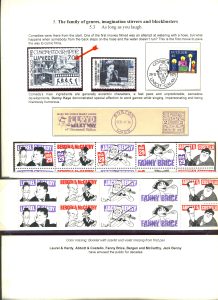
I started collecting stamps when I was 6 years old. Initially, these were stamps from all over the world. I received stamps from family members, friends and neighbors. I remember how I used to sort the stamps by country and at a certain time how I counted how many stamps I had and always, when I reached numbers like 12,354 stamps, I got confused and started counting
again…
At a later age, at the age of 18, I walked into a stamp shop, and on the counter was a Sunday envelope with movie actors stamps. I was fascinated by actors I know from movies I loved about stamps. At that moment, I didn’t know that there were many countries that used this motif to make money from the sale of stamps, and at that time, of course, there was no supply like today. I started looking for and collecting stamps related to those heroes, actors or stars (stars) I knew. Slowly I was exposed to the subject. After about two years I presented one frame for the first time at the Philatelic Club in Tel Aviv, I remember that it took me a while to prepare a plan, to arrange, to find suitable material, and even then I was missing proper material for one frame. Slowly I developed and perfected philatelic material, searching and correspondence with collectors and dealers in pursuit and search for stamps and other items.
I chose to display some of my collections here on the site.
The website is non-commercial and is intended to serve as an information archive for public use.
CINEMASTAMPS website exhibits: a collection of philatelic items on the subject of cinema as presented in stamp exhibitions around the world and has achieved achievements. You can also get acquainted with the cinema in the Land of Israel through a philatelic view, in a collection of postcards and postal items.
Cinema at the forefront
I chose to concentrate on a unique category here on the World War I site in 1914-1918 for displaying postal items, postcards, photographs, newspaper clippings, and sometimes also movie cards. A period of enormous war with millions of dead and soldiers went to the movie in order to forget about the horror of war, to distract.
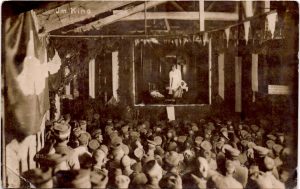
The importance of cinema in everyday life during the war years is important. The genres that were preferred in thecinemas in the field included melodramas and comedies, also known as comedies or humorous ones.
Film departments were established within the framework of the war press bureaus in the various countries in 1914. The tasks of this department included the recruitment of film units composed of enlisted film experts, who would shoot films on the front, at headquarters, and behind the lines. A film laboratory was also set up in the department and all films were subject to censorship. The film department was tasked with making propaganda films, films showing the work inside a POW camp or occupied territory; War and agriculture industry films, propaganda dramas or feature films.
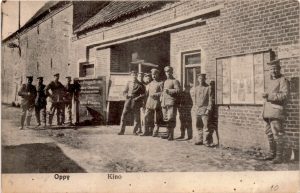
The propaganda films were also screened during the regular operation of the cinema through mobile cinemas and cinemas that were set up specifically to distract and refresh the spirits of the soldiers. British prisoners of war from World War I set up and ran their own cinemas while held by the Germans – even watching movies regularly with their captors. Soldiers held behind barbed wire hoping to find a distraction from hunger and cold were able to buy equipment needed to build their own homes. Movies are becoming a popular pastime, helping people pass the time and find some respite from the harsh camp conditions.
Prisoners rejected attempts to get them to watch propaganda, and German camp commanders regularly canceled screenings, but were encouraged to go to the cinema because they thought it would prevent disorder. The cinemas were, among other things, barns or theaters, or temporary wooden structures. Soldiers had to organize equipment, find funding, translate titles in foreign languages, and provide musical accompaniment. Screening films was a technical job, and soldiers had to make contact with the German film industry – with the help of their captors – to find films to screen. Other soldiers were held in labor camps in much more basic conditions, watching movies in the fields at night projected on a sheet or wall. These makeshift cinemas were run by camp commanders, with projectors circulating in the various camps. Prisoners were also allowed to visit local movie theaters, where they could see French or German films.
It seems that most of the prisoner of war cinemas were built from 1916 onwards. There is little evidence of designated movie theaters, but soldiers do mention films that are shown in existing buildings such as theaters, halls, or stables.
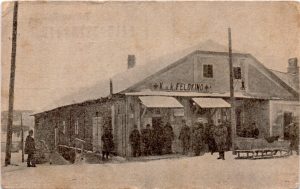
For the challenges of the search, I chose to collect, in addition to military postcards from the years 1914-1918 related to cinema, regular postcards that show movie theaters but were sent by military mail in the years 1914-1918
We would be happy to receive corrections / updates / photos
Anyone who has information to complete, whether by correcting or updating the name of a place, city, country or even a correct and appropriate text for publication is welcome to send. Anyone who has images to the supplier is welcome to send them in a JPG file with the sender’s name credit and we will gladly publish them.